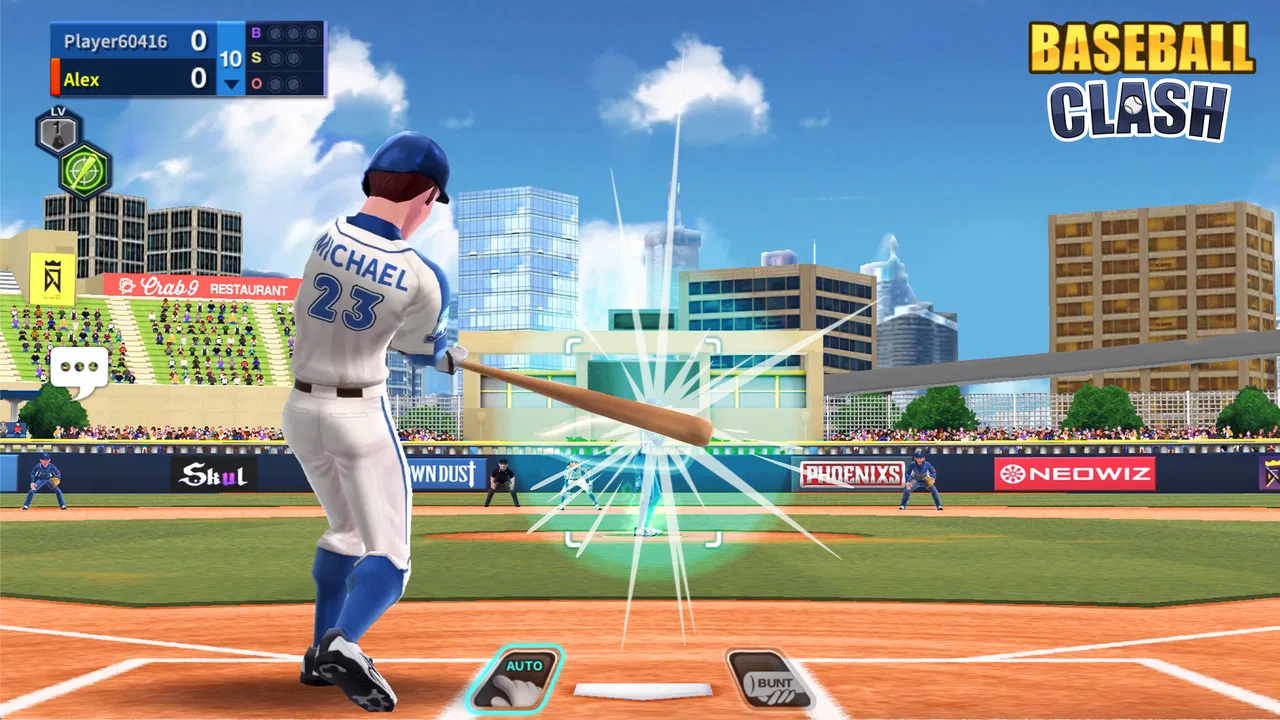
Baseball Clash: Real-time game
- 4.4
- Rating
- 5.00M
- Installs
- Free
- Price

 Analysis by App-foxy
I spent time with Baseball Clash as a quick, competitive sports game, and my first impression was that it understands the value of a short match. It is built around baseball rather than a long simulation, so the appeal comes from making a decision, taking an action, and seeing the result without having to learn a huge rulebook first. That makes it approachable, although the simple entry point does not mean every part of the experience stays equally comfortable for every player.
Miniclip.com presents it as a free game for Android, with an Everyone content rating and support for Android 7.0 or later. The game was released on November 6, 2020, and its current version is 1.2.0033258. It has reached over five million installs, with an average score of 4.4 from roughly ninety-two thousand ratings and about twelve thousand written reviews. Those figures suggest a well-established audience, but they do not replace the more useful question: whether its fast, touch-focused design fits the way you want to play.
How Baseball Clash feels to use across different situations
I find that Baseball Clash’s defining strength is how quickly it turns a spare moment into a focused baseball match. That suits the times when I want to make a few active decisions rather than settle into a long simulation. The same immediacy also makes the setting matter: a quiet pause feels very different from a rushed session with distractions, which is where its everyday tradeoffs become clear.
You May Also Like

 Blood Strike: 2.5 Anniversary
Blood Strike’s Loadouts Turn Every Drop Into a Tactical Gamble
A close look at Blood Strike’s custom loadouts: how fast access to signature weapons reshapes its battle royale rhythm, rewards preparation, and narrows the gap between fights.

 Pandora - Music & Podcasts
Pandora’s Music Is Easy to Start, but Harder to Recover
Pandora’s strength is its low-effort path from a seed to a station. Its weak spot is how much confidence it asks you to place in connection, setup, and quiet recovery.

 8 Ball Pool
 Is Built on Rivalries, Rematches, and Routine
A close look at the rivalries, rematches, shared routines, and unanswered safety questions that turn a quick pool match into a persistent mobile community.

 Samsung Music
’s Quiet Strength Is Playing What You Already Own
Its reach comes less from spectacle than from dependable access to a personal library. That simplicity is both the app’s strongest retention engine and its ceiling.

 AccuWeather: Weather Radar
AccuWeather Review: A Quick, Clear Forecast for Everyday Decisions
For everyday plans, the best forecast is the one you can understand quickly. AccuWeather makes rain timing, radar, and local conditions easy to act on, with a few trade-offs.

 Hill Climb Racing
Why Hill Climb Racing Still Turns Crashes Into One More Run
A tiny car, a bumpy hill and one more upgrade: Hill Climb Racing keeps resurfacing because its simple chaos makes every near-miss feel personal.
More From Our News Desk
View All News


Readable screens and a navigation style that gets out of the way
The strongest accessibility quality I noticed is the straightforward structure. I can move from the opening screen toward a match without feeling as if I need to decode a complicated sports-management interface. That matters for new players, younger users, and anyone who prefers to learn by doing rather than reading several layers of instructions.
The baseball presentation also helps with orientation. The important action is placed in the center of attention, while surrounding menus support the match rather than competing with it. I found that useful when returning after a break: I did not have to rebuild a mental map of a large strategy system before playing again. For a casual session on a phone, clear visual hierarchy is more valuable than a deep collection of menus.
There is a trade-off, though. A compact interface can make information feel condensed, especially when several game elements appear during a live exchange. Players with reduced vision, reading difficulties, or a preference for very large controls may find that the default presentation asks for more visual attention than expected. I would recommend trying it on the device you actually use, because screen size and display scaling can change how comfortable the menus feel.
I also would not confuse an easy-to-understand layout with a fully customizable one. The game is welcoming because it keeps the path into a match simple, not because it offers a broad set of documented display adjustments. If you need high-contrast modes, text enlargement, color filters, or extensive interface remapping, this is a point to check personally before committing to regular play.
Touch actions, timing, and motor demands
The central control idea is easy to grasp: baseball actions are handled through touch, and the outcome depends on making the right move at the right moment. That gives the game a satisfying sense of immediacy. I can play with one hand during a short pause, and I do not need a physical controller or a desk setup to understand what the game expects.
That same immediacy creates the main motor challenge. Fast touch interactions can be uncomfortable for players with tremors, limited dexterity, slower reaction times, or difficulty maintaining a precise finger position. A control scheme that feels wonderfully responsive to one person can feel unforgiving to another. In my experience, the game is at its best when I am alert and holding the phone securely; it is less comfortable when I am walking, carrying something, or trying to play with an awkward grip.
A useful practical approach is to treat it as a short-session game rather than forcing long play periods. Resting between matches reduces the strain caused by repeated taps and helps preserve accuracy. I also found that playing while seated is preferable to trying to react during a commute or in a crowded place. The game may be easy to start, but its real-time nature rewards a stable posture and an unobstructed view.
Players who need slower input, generous timing windows, alternative controls, or complete one-handed support should be cautious. I would choose a turn-based baseball game instead if my priority were relaxed decision-making rather than quick reactions. Baseball Clash is more suitable for someone who enjoys brief bursts of touch-based competition and can comfortably respond to changing on-screen action.
Visual and sensory comfort during a match
The game’s appeal depends on instantly noticing what is happening. That usually makes the experience lively, but it also means visual attention is part of the challenge. If you are sensitive to rapid movement, bright effects, or busy moments on screen, a match may demand more concentration than the simple premise suggests.
Sound can also influence how connected the match feels, but I would not make audio essential to understanding the game. In everyday use, I prefer playing with the volume lowered or muted when I am in a shared space. That makes it more practical in a waiting room, office break, or public transport. The important consideration is whether you can still follow the action comfortably when you are not relying on sound cues.
For players with color-vision differences, the safest habit is to pay attention to shape, position, and motion rather than color alone. I would not assume that every visual distinction will be equally clear to every player. If a particular matchup or action becomes hard to read, changing the phone’s brightness and viewing angle may help, although that is a device-level workaround rather than a dedicated game accessibility feature.
Young players may appreciate the Everyone rating because the game is positioned as suitable for a broad audience. Adults should still remember that suitable age labeling does not guarantee that every child will find rapid touch actions comfortable or understand purchase prompts independently. The game is free to install, but in-app purchases range from $0.99 to $119.99 per item, so family use deserves ordinary supervision around spending.
Where it works well in everyday life
I think the best real-world use case is a short break when I want interaction rather than passive entertainment. A few minutes can be enough to play, and the sports format gives the session a clear beginning and end. That is more convenient than a lengthy simulation when I am waiting for an appointment or taking a brief pause between tasks.
It is also a reasonable choice for introducing someone to mobile sports games. A friend who does not normally play baseball simulations can understand the basic goal without first studying player statistics, league structures, or complex defensive positioning. I would sit beside a new player for the first match, explain the timing, and then let them experiment. The game’s approachable surface makes that kind of informal handoff easy.
However, real-time play is not equally practical everywhere. On a noisy bus, in bright sunlight, or while multitasking, I may miss visual details or make rushed touches. Someone with limited data access, an inconsistent connection, or a need to avoid interruptions should test the game in their usual environment rather than judging it only from a quiet room. Competitive timing is much less enjoyable when the surrounding situation keeps breaking concentration.
Another situational issue is social comfort. A phone game can be discreet, but the need to watch the screen closely makes it less suitable when I should be paying attention to a conversation, crossing a street, or handling a task. The game is accessible in the sense that it fits into a phone, yet it still requires the player to reserve attention for the match.
Progression, spending, and the cost of convenience
The free price makes trying it straightforward. I can install the game without making an upfront commitment, which is useful if I am unsure whether quick multiplayer baseball will hold my interest. That low entry barrier is one of its practical strengths, especially compared with paid sports titles that expect me to decide before playing.
The more important decision comes afterward. In-app purchases are available across a very wide range, from $0.99 to $119.99 per item. I would approach those purchases as optional spending rather than part of the basic test. A sensible workflow is to play first, decide whether the core matches remain enjoyable, and only then consider whether any purchase genuinely improves my experience. This is particularly important for families and for anyone who prefers a fixed entertainment budget.
Players who dislike competitive games with optional spending may feel more comfortable with a premium sports game or a single-player title bought once. Those alternatives can offer a calmer relationship with progression, even if they lack the quick multiplayer focus here. On the other hand, someone who wants to sample a baseball game at no initial cost may find the free download more appealing than paying upfront for a deeper but less immediately approachable alternative.
My advice is not to judge the game by how quickly it can be installed. Judge it by whether the basic match loop is enjoyable before spending anything. That separates the genuine appeal of the controls and competition from the temptation to pay for convenience or faster progress.
Remaining barriers that affect inclusion
The biggest barrier is the combination of real-time pressure and touch precision. It narrows the audience more than the simple controls do. A player can understand every instruction and still struggle because the required response is too quick, too small, or too dependent on steady finger movement. This is the difference between being easy to learn and being easy for everyone to play.
Another barrier is the limited room for personal adjustment that I could identify during normal use. Players who depend on extensive text, color, timing, or control customization may need to rely on phone settings or personal workarounds. Those solutions can help, but they are not the same as having the game designed around a wider range of abilities from the start.
Attention is a further consideration. The game is a poor fit for someone who needs to look away frequently, play without visual focus, or avoid rapid on-screen changes. I would not recommend it as an audio-first experience or as a game to operate while doing another activity. Its strengths come from watching the action and responding directly, so those requirements should be treated as central rather than incidental.
There is also a difference between accessibility and familiarity. A player who already understands mobile sports controls may find the interface immediately comfortable, while someone new to touch gaming may need several attempts before the timing feels natural. Helping a new player by demonstrating one action at a time works better than explaining the entire game in advance. That small change can make the first session less intimidating.
Who should play it, and who should choose something else?
I would recommend it to players who want a free sports game that starts quickly, fits into short sessions, and makes baseball feel active rather than statistical. It is especially appealing if you enjoy learning through repeated matches, prefer touch controls to a controller, and like the pressure of making a timely decision.
I would be more hesitant to recommend it to someone seeking a detailed baseball simulation. If you want extensive roster management, slow tactical planning, or a strong offline-first experience, a traditional simulation may be a better match. Its extra depth can be worth the added complexity when realism matters more than immediate play.
I would also point players with motor or sensory needs toward a trial-first approach. The Everyone rating is reassuring for broad age suitability, but it does not tell me whether the fast touch interaction, visual presentation, or available settings will work for a particular person. Try a short session in the conditions where you expect to play, such as with reduced sound, one hand, a larger display, or a busy environment.
For families, the game can be a fun shared introduction to baseball, provided an adult handles spending expectations and helps younger players understand the match rhythm. For adults wanting a quiet wind-down, it may be less suitable because competition and timing keep the mind engaged. I see it as a focused mini-session, not automatically as a relaxing background game.
My inclusive verdict after playing
Baseball Clash succeeds at making mobile baseball feel approachable without requiring a long setup. Miniclip.com has built a sports game that is easy to pick up, free to try, and well suited to quick competitive sessions. Its established audience, reflected in the strong average rating and millions of installs, makes it a credible choice for anyone curious about this style of play.
My positive view comes with a clear condition: the game is most inclusive for people who can comfortably see fast-changing action and make reasonably precise touch responses. It supports casual access through a simple structure and a familiar phone format, but it should not be mistaken for an experience designed around extensive accessibility customization.
The best way to decide is to test the basic match loop before spending money. Play in your normal environment, check whether the screen remains readable, see whether the timing feels manageable, and notice how comfortable your hand is after several rounds. If those elements work for you, this is an enjoyable way to fit baseball into a spare moment. If they do not, a slower, turn-based, controller-friendly, or more adjustable sports game will probably serve you better.
For my own use, I would keep it installed for short breaks and quick matches, not as my only baseball game. That feels like the fairest description: a lively, accessible starting point with a clear audience, but also with real motor, visual, situational, and spending considerations that every player should weigh before making it a regular habit.
FAQs for Baseball Clash: Real-time game
01What is Baseball Clash: Real-time game?
Baseball Clash: Real-time game is a dynamic and engaging mobile game that offers players a chance to experience real-time baseball matches against others worldwide. It combines strategy, quick thinking, and skill to provide an authentic baseball gaming experience on both Android and iOS platforms.
02How do I play Baseball Clash: Real-time game?
In Baseball Clash, you build and manage a team of players, each with unique skills and abilities. Matches are played in real-time, requiring strategic pitching, batting, and fielding. The game offers a tutorial for new players, ensuring a smooth learning curve as you master the gameplay mechanics.
03Are there in-app purchases in Baseball Clash?
Yes, Baseball Clash includes in-app purchases that allow players to buy various items such as player upgrades, new characters, and other enhancements. While the game is free to download and play, these purchases can enhance your gaming experience and expedite your team's progress.
04What are the system requirements for Baseball Clash?
Baseball Clash requires a device running Android 5.0 or later, or iOS 10.0 or later. It is recommended to have a stable internet connection for seamless real-time gameplay. The game is optimized for both smartphones and tablets, providing a flexible gaming experience across devices.
05Can I play Baseball Clash offline?
No, Baseball Clash: Real-time game requires an active internet connection to play. Since the game focuses on real-time matches against other players worldwide, being online is essential for matchmaking and gameplay. Offline modes are not available, so ensure your device is connected to the internet.
Pros
- Fast-paced gameplay keeps you engaged.
- User-friendly interface for easy play.
- Real-time matches with global players.
- Strategic elements enhance depth.
- Regular updates with new content.
Cons
- In-app purchases can be pricey.
- Occasional connectivity issues.
- Limited offline features.
- Some ads interrupt gameplay.
- Matchmaking can be uneven.

Baseball Clash: Real-time game
Gallery